
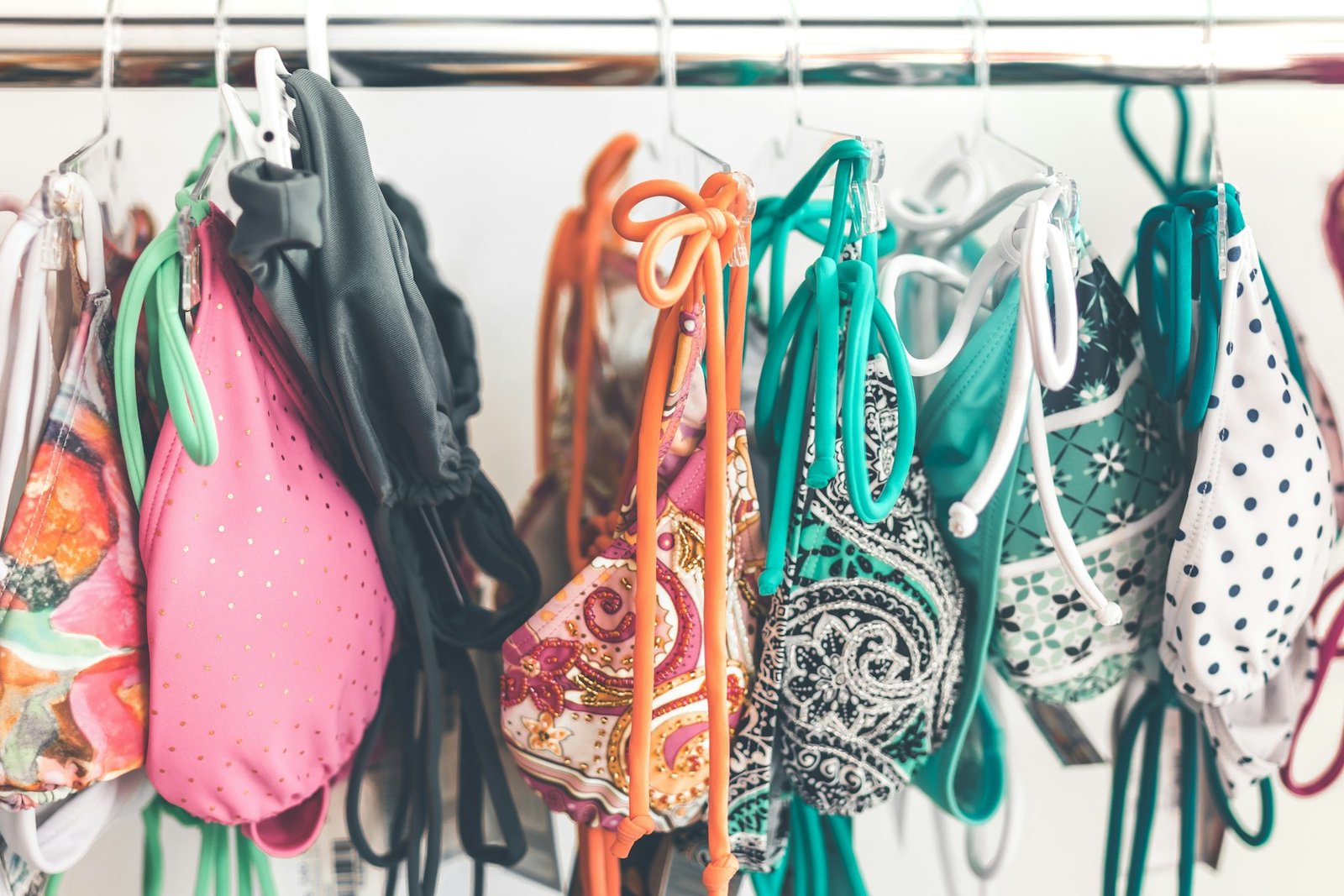
Swimsuit shopping has a reputation. Fluorescent changing rooms, mystery sizing, a mirror that seems to have a personal grudge. But here’s the thing nobody says out loud: a lot of the misery comes from habits, not from you. Small, fixable, totally understandable habits that keep landing you in suits that dig, slip, sag or sit in a drawer with the tags still on.
So consider this an intervention from a friend who has opinions about elastic. Below are eleven of the most common swimsuit shopping mistakes, why they happen, and what to do instead. No judgement. Okay, a little judgement. But only of the habits.
Quick takeaways
- Your swim size is not your dress size. Measure, then check each brand’s own chart.
- Buy separates when your top and bottom need different sizes. That’s what they’re for.
- Test every suit sitting, bending and lifting your arms, not just standing still and hoping.
- Read the fabric and lining details. They tell you more than the product photo ever will.
- Shop for the day you’ll actually have, not the day in the advert.
The sizing sins
1. Assuming your swim size matches your clothing size
It would be lovely if it did. It doesn’t. Swimwear is cut closer to the body and made from stretchier fabric, and every brand grades its sizes differently. A medium in one label can behave like a small or a large in another. Treat the letter on the tag as a rough suggestion, not a personality trait.
The fix takes about five minutes: grab a soft tape measure, take your bust, underbust, waist, hips and torso measurements, and compare them with the brand’s own size chart every single time. Our guide to measuring for a swimsuit walks you through it.
2. Sizing down “for motivation” or “for extra hold”
A suit that’s too small doesn’t hold you in. It holds a grudge. Edges roll, straps dig, leg openings bite and the whole thing rides up the moment you sit down. Buy for the body you’re taking to the beach this season, because that’s the body that deserves to be comfortable.
3. Forcing a matching set when you’re two different sizes
Plenty of people wear a different size on top than on the bottom. That’s not a fit problem, that’s just bodies. If a set only comes as a fixed pair, one half is almost guaranteed to be wrong. Look for separates sold individually, so the top fits your bust and the bottom fits your hips, and nobody has to compromise.
4. Ignoring torso length
This one is mostly a one-piece crime. If your torso is longer or shorter than the pattern assumes, the suit either pulls down on your shoulders and up at the legs, or bunches around your middle like a deflated pool float. Some brands list torso measurements or offer long-torso cuts. Check before you buy, and look for adjustable straps if you’re on either end of the scale.
The try-on blunders
5. Doing the statue test
You stand perfectly still, suck in a breath, turn slightly to one side and decide it’s fine. Then you get to the beach and discover the suit has entirely different plans for a person who moves. Swimwear has to cope with sitting, bending, reaching, walking and swimming.
Pro tip: Run the full drill before the tags come off. Sit down for a minute, bend forward as if picking up a towel, raise both arms over your head and twist side to side. If anything gapes, rolls, slides or pinches, it will do it ten times more in the water.
6. Trying it on over your underwear and calling it research
Hygiene liners and keeping your underwear on in shop changing rooms are perfectly sensible. But a bulky pair of briefs underneath changes how a bottom sits and can hide a leg opening that’s cut too high or too tight. At home, where you can try it properly with the hygiene liner in place, check the fit honestly before deciding to keep it.
7. Skipping the return policy
Many retailers have stricter rules for swimwear than for other clothing, often requiring the hygiene liner to stay in place and the tags to stay on. Some don’t accept swimwear returns at all. Read the policy before you order, not after you’ve fallen out of love with your purchase. If you’re buying online, ordering two sizes from a retailer with easy returns can save you a lot of guesswork.
The “I didn’t read the label” club
8. Ignoring fabric and lining
The product photo is a mood. The fabric description is the truth. Thin, unlined suits can turn sheer when wet, lose their shape quickly and cling to every ripple. Denser fabrics with a good share of elastane recover their shape better, and a full lining adds opacity and structure. If the listing doesn’t mention lining at all, be suspicious. Our swimwear fabrics guide explains what the common blends actually do.
9. Buying support that’s purely decorative
Tiny triangle tops are adorable. They are also, for many busts, about as supportive as a strongly worded suggestion. If you need lift and hold, look for structural features: underwires, wider underbands, adjustable and wider straps, moulded or sewn-in cups, and tops sized by bra size rather than S/M/L. Our guide to swimwear for larger busts covers which features actually do the lifting.
The big-picture mistakes
10. Shopping for a fantasy, not your actual plans
The suit that looks perfect lounging on a sunbed may be a disaster in surf, on a paddleboard or while chasing a toddler across the sand. Before you buy, picture what you’ll realistically be doing. Lots of swimming and waves call for secure straps, fuller coverage and fabrics that stay put. Lounging and reading can be as decorative as you like. For the active stuff, see our guide to swimwear for active days.
| Your plan | What to prioritise | What to skip |
|---|---|---|
| Lounging and reading | Comfort, colours you love, easy cover-up pairing | Nothing, honestly. Go wild. |
| Swimming laps | Chlorine-resistant fabric, secure straps, streamlined cut | Ties, loose ruffles, heavy hardware |
| Surf and waves | Full coverage, crossed or thick straps, snug bottoms | Bandeaus, side ties, very cheeky cuts |
| Beach with kids | Coverage when bending, sturdy fabric, quick-dry | Anything you need to adjust every two minutes |
11. Buying what you think you’re “supposed” to wear
Here’s the big one. Too many people walk past the suit they actually love because some magazine once decreed a rule about age, size or shape. Then they buy something “appropriate” that they feel nothing about, and it shows. The best swimsuit is the one you feel comfortable, secure and like yourself in. Want the bright print? Get the bright print. Want the high-cut leg? Go for it. Want full coverage because it feels good? Equally valid.
Consider this your permission slip. Signed, stamped and laminated.
Bonus round: the post-purchase slip-up
You found the one. Congratulations. Now please don’t throw it in a hot wash, leave it balled up in a wet bag overnight or bake it on the balcony railing. Heat, chlorine and sunscreen all break down elastane over time, and once the stretch goes, so does the fit. Rinse in cool water after every swim, wash gently by hand and dry flat in the shade. Do that, and your favourite suit will thank you by lasting more than one summer.
What to look for when you shop
- A detailed size chart with bust, underbust, waist and hip measurements, not just letters.
- Tops and bottoms sold separately, so you can size each half independently.
- A clear fabric description that mentions elastane content and full lining.
- Real support features if you need them: underwire, wide underband, adjustable straps.
- Torso length information or long-torso options for one-pieces.
- A cut that suits what you’ll actually be doing in it.
- A return policy you’ve read and understood before checkout.
FAQ
Should I size up or down in swimwear?
Neither by default. Measure yourself and follow the brand’s own size chart. If you fall between sizes, read the product description, as some brands recommend going up in firmer or shaping styles. Sizing down for “hold” usually just leads to rolling and digging.
How should a swimsuit feel when I try it on dry?
Snug but comfortable. Many swim fabrics relax slightly once wet, so a suit that’s loose when dry may sag in the water. At the same time, it shouldn’t leave deep marks or make sitting uncomfortable.
Is it worth buying swimwear online?
Absolutely, as long as you measure first, read size charts and fabric details carefully, and check the return policy. Online shopping often gives you far more size and style options than a single shop can stock.
How many swimsuits do I actually need?
It depends on how often you swim, but two is a good minimum if you’re in the water regularly. Rotating gives each suit time to dry fully and recover its stretch, which helps both last longer.
Swimsuit shopping doesn’t have to be a seasonal ordeal. Measure, read the label, move around in the changing room and buy what you genuinely like. Do that, and the only thing you’ll be adjusting at the beach is your sun lounger.